Cordia Woodland and the Miele Cooker Hood: 90 Degrees, a Saddle Fitting and a Shared Riser
A premium cooker hood the manufacturer's service refused to connect – first "a T-piece, as per the design", then it turned out to be an angle-ground hole, silicone and a saddle fitting
Location: Cordia Woodland, Vágóhíd utca 9, 1097 Budapest – Building B
Appliance: Miele DAH 4980 Sienna wall-mounted cooker hood
Problem: the kitchen exhaust branch joins the vertical riser at 90 degrees via a saddle fitting; Miele accepts no responsibility for that kind of connection
Duration: since 5 May 2026, still unresolved
Outcome: according to Pedrano, a 45-degree connection is technically not feasible and the cooker hood is "not suitable" for the building's system
In February I moved into the Cordia Woodland complex. A new flat, a new kitchen – and a cooker hood I chose to last for years: a Miele DAH 4980 Sienna. A premium appliance, a 10-year warranty, an installation manual of more than 40 pages. The manufacturer's/retailer's service came out, looked at the duct stub sticking out of the wall – and didn't connect it.
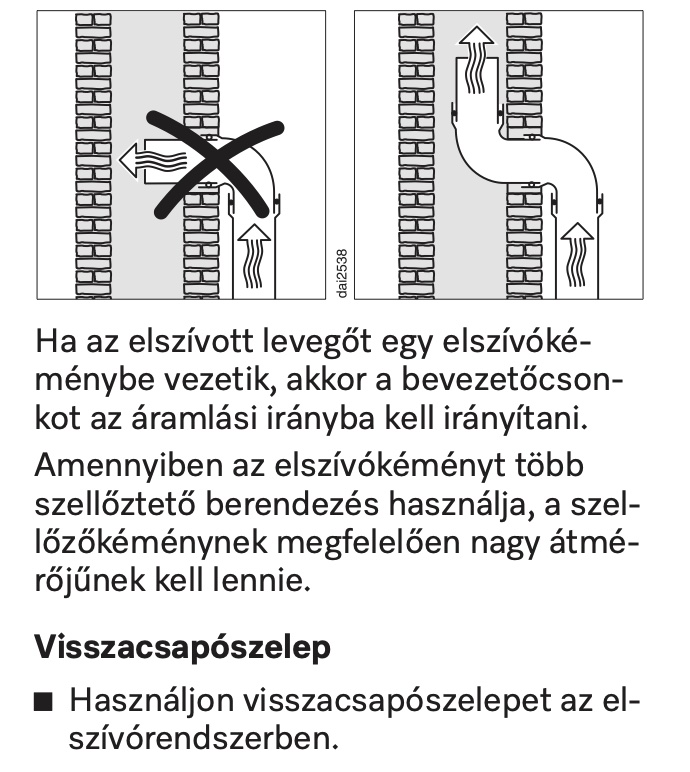
The reason: the flat's exhaust branch joins the vertical ventilation riser at 90 degrees, while the manufacturer expects a connection of at least 45 degrees, pointing in the direction of flow, in apartment buildings. Connected as it is, the service said, the hood won't extract properly and the motor could fail. This case study covers what Pedrano – the office handling Cordia's warranty claims – said about it, what turned out along the way about the "T-piece", and what the numbers show when six to ten kitchen hoods share one riser. It's one of those cases that cost me not only time but nerves – and probably a few more gray hairs.
The Appliance: Miele DAH 4980 – a Manual That Actually Explains the Connection
The operating and installation instructions for the Miele DAH 4980 run to 42 pages, and the installation chapter (pages 31–37) deals specifically with the exhaust duct. The points that matter here:
- Exhaust shaft (page 35): if the exhaust air is fed into a shared shaft, the inlet must point in the direction of flow. If several ventilation appliances use the same shaft, it must have a correspondingly large diameter.
- The exhaust duct (page 35): as short and straight as possible, large-radius bends only, and never narrower than the appliance's outlet (Ø 150 mm).
- Non-return valve (pages 31 and 35): Miele explicitly requires one and supplies one, fitted into the fan outlet.
- Make-up air (pages 14 and 26): in extraction mode, incoming air improves efficiency; without enough make-up air the hood doesn't work efficiently and operating noise increases.
- Liability (page 36): Miele accepts no liability for malfunctions or damage caused by an unsuitable exhaust duct.
The Stub That Doesn't Come Out of the Wall Straight
The first oddity is visible inside the flat. The 160 mm duct stub isn't perpendicular to the wall: it sticks out roughly 10 degrees off, outwards, towards the kitchen. A straight, rigid 160 mm pipe simply can't be fitted onto it properly.
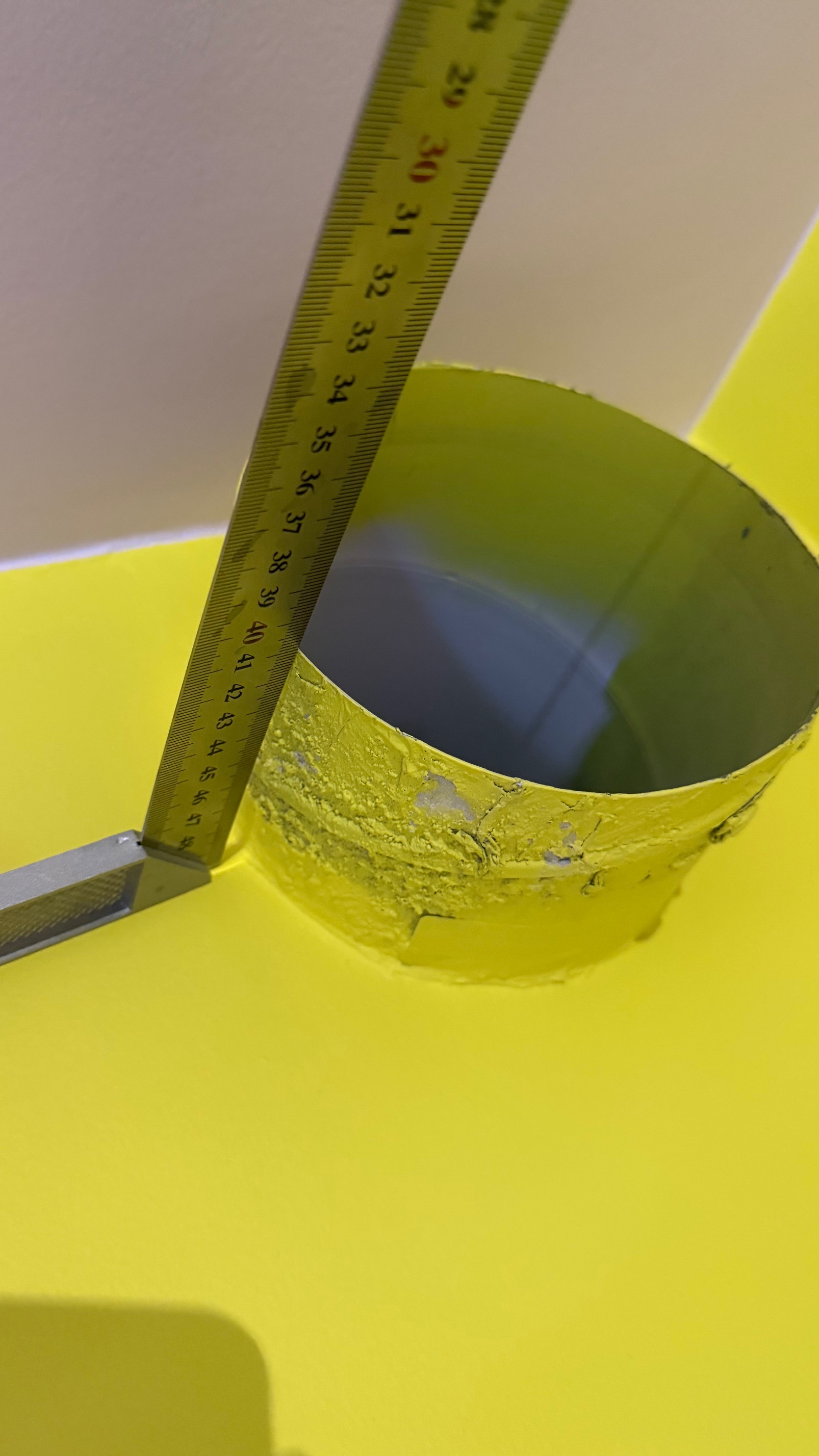
Pedrano's answer on 8 June was that cooker hoods are connected with flexible, not rigid, ducting, so the angle isn't an issue. But Miele's manual asks for exactly the opposite – smooth ducting, as straight as possible, with large-radius bends – and the real problem isn't outside the wall anyway. It's inside, in the shaft.
"A T-Piece, as per the Design" – or Not?
On 5 June 2026, Pedrano wrote that the flat's exhaust branch joins the vertical duct in the shaft with a T-piece, in line with the construction drawings, current building practice and the regulations.
On site, we saw something else. There is no T-piece. The vertical duct had been cut open from the side – clearly with an angle grinder, and not very neatly – and a fitting placed over the hole, fixed and sealed with silicone. On top of that, the hole was nowhere near 160 mm: it came out smaller than the connecting pipe. Workers sent out through Pedrano's warranty process later widened it with a keyhole saw – otherwise the wall would have had to be opened.
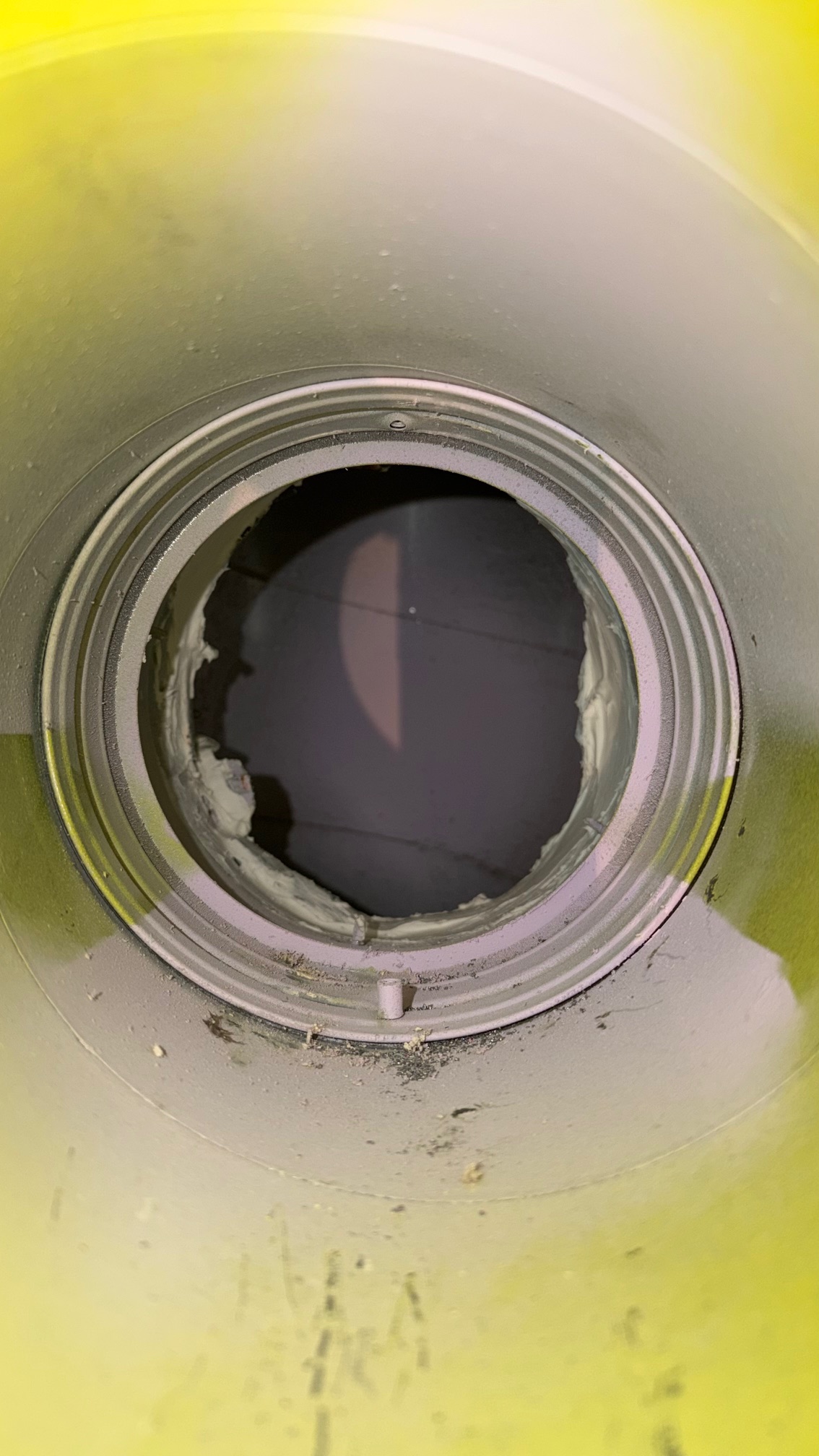
I pointed this out in writing on 8 June and again on 21 June. After my follow-up on 25 June, Pedrano corrected its earlier statement: the connection was indeed made not with a T-piece but with a saddle fitting. As they described it, an opening is cut into the vertical duct, the saddle fitting is placed over it, and airtightness is ensured with sealant. The reason given: according to the mechanical contractor, there isn't enough room in the shaft for a T-piece.
The Correspondence, Step by Step
– the exhaust branch joins the vertical duct with a T-piece, in line with the design, practice and regulations;
– if Miele sticks to its position, then in their view the appliance can't be installed in my flat, and that concerns the sale, not them;
– the flat's user guide limits cooker hoods to max. 270 m³/h, and the building's ventilation system was built for that capacity;
– the more air flows, the greater the resistance of a 90-degree turn;
– in their view Miele's solution is not feasible in an apartment building, and even one such connection would degrade extraction in the other flats.
– Miele's solution is not feasible in an apartment building;
– any opening or alteration of the services shaft voids the warranty in every affected area, and the building's community forbids it;
– on the angled stub: cooker hoods are connected with flexible ducting.
I also write that Miele is asking me to sign a declaration: if the motor or the hood fails because of the improper connection, I lose the 10-year warranty. I can only sign it if Cordia commits, in a signed company document, to repairing the hood over the next 10 years should it fail for that reason.
– they won't carry out the requested work, consider it technically not feasible, and don't recommend it given the shared ownership of the building;
– according to the contractor, a duct can't leave the shaft at 45 degrees because the shaft wall is a fire barrier and the fire damper works in the plane of the wall;
– a 45-degree connection would require turning the duct horizontal inside the shaft, which would need about 50 cm of extra room;
– in their view the hood is not suitable for the building's system, either in performance or in its installation requirements.
My request for a quote went unanswered.
– the exact riser diameter, and whether it widens further up;
– whether it really was sized at 270 m³/h per flat, and how many flats extracting at once the designer assumed;
– how the system behaves when several flats cook at the same time;
– whether the riser has natural or mechanical (fan-driven) extraction;
– whether there are non-return valves in the branches, since the neighbours and I notice odours getting in;
– the relevant part of the ventilation design drawings and the user-guide clause containing the 270 m³/h limit.
T-piece, saddle fitting. On 5 June it was a T-piece, "as per the construction drawings". Three weeks later it turned out to be a saddle fitting, because there's no room for a T-piece. So do the drawings show a saddle fitting too – or does the as-built state differ from the design?
Angle grinder, silicone, keyhole saw. The hole was smaller than the connecting pipe and had to be widened later with a keyhole saw. If that's "current building practice", I'd be curious how many flats look the same.
"The appliance isn't suitable". The Miele's stage 1 is 215 m³/h – below Pedrano's 270 m³/h limit. So the problem isn't only performance; it's that the connection can't be made the way the manufacturer requires.
Fire safety – a genuine argument. A fire-rated shaft wall and a fire damper working in the plane of that wall are serious considerations, and I don't dispute them. Which is exactly the question: if fire safety means only a 90-degree connection is possible in this building, why doesn't the buyer find that out before buying a cooker hood?
Let's Do the Maths: How Much Air Are We Talking About?
According to Miele's data sheet (measured to EN 61591), the DAH 4980's airflow per stage is shown below. Next to it I've put Pedrano's 270 m³/h building limit, and what that means for air velocity in the appliance's 150 mm outlet and in the 160 mm branch duct.
| Stage | m³/hour | m³/minute | litres/second | Velocity in Ø150 mm | Velocity in Ø160 mm |
|---|---|---|---|---|---|
| Stage 1 | 215 | 3.6 | 60 | 3.4 m/s | 3.0 m/s |
| Pedrano limit | 270 | 4.5 | 75 | 4.2 m/s | 3.7 m/s |
| Stage 2 | 315 | 5.3 | 88 | 5.0 m/s | 4.4 m/s |
| Stage 3 | 415 | 6.9 | 115 | 6.5 m/s | 5.7 m/s |
| Booster 1 | 660 | 11.0 | 183 | 10.4 m/s | 9.1 m/s |
| Booster 2 | 875 | 14.6 | 243 | 13.8 m/s | 12.1 m/s |
What does this mean in practice?
- Stage 1 (215 m³/h) fits within Pedrano's 270 m³/h limit. Stage 2 exceeds it by 17%, stage 3 by 54%, and Booster 2 by more than three times.
- The loss in a 90-degree turn grows with the square of velocity. In the 160 mm branch, dynamic pressure is about 8 Pa at 270 m³/h, about 20 Pa at stage 3 and about 88 Pa at Booster 2. Pedrano is right on this: the more air you push, the more the right angle hurts. The same argument, though, speaks for a 45-degree connection in the direction of flow.
- These are free-blowing lab values. On a real duct, with resistance, actual airflow is lower. According to Miele's data sheet, the fan's best efficiency point is around 421 m³/h at 408 Pa.
- For a single flat, the diameter isn't the bottleneck. The Miele's outlet is 150 mm and the branch is 160 mm – about 14% more cross-section than the appliance, just as the manual asks. If only one flat extracts, even stage 3 (415 m³/h) runs at just 5.7 m/s in the 160 mm branch, a perfectly normal value. So Miele's service didn't object to the diameter; it objected to the 90-degree direction. The 270 m³/h limit really only makes sense where flats share something – the common riser.
Note: the values above come from the data sheet on Miele's product page. The EU data sheet at the end of the installation manual gives 218 / 420 / 884 m³/h for the DAH 4980; the difference doesn't change the conclusions.
What Pedrano Says – and What I Measured
According to Pedrano, the flat's user guide limits cooker hoods to max. 270 m³/h, and the building's ventilation system was built for that capacity. They never gave the riser diameter, though. So I measured it from the inside at my own flat on the 6th floor: not an easy measurement, but it looks like about 180 mm.
The flats on floors 5 to 10 are connected to my riser, one per floor – six kitchens. The 5th floor is the first; no flats on floors 1–4 connect to this riser. I live on the 6th floor, so my hood is second in line. Air accumulates from the bottom up: each floor adds another kitchen, so a different amount of air passes through each section of the riser.
If everyone keeps to 270 m³/h and cooks at the same time
| Riser section | Hoods whose air passes through | Total m³/h | Diameter needed (approx. 5 m/s) | Velocity if 180 mm all the way |
|---|---|---|---|---|
| Between floors 5 and 6 | 1 | 270 | approx. 140 mm | 2.9 m/s |
| Between 6 and 7 – just above my connection | 2 | 540 | approx. 195 mm | 5.9 m/s |
| Between 7 and 8 | 3 | 810 | approx. 240 mm | 8.8 m/s |
| Between 8 and 9 | 4 | 1,080 | approx. 275 mm | 11.8 m/s |
| Between 9 and 10 | 5 | 1,350 | approx. 310 mm | 14.7 m/s |
| Above floor 10, towards the roof | 6 | 1,620 | approx. 340 mm | 17.7 m/s |
My measurement (about 180 mm on the 6th floor) may be roughly fine for the lowest section – borderline for two hoods. But if the riser is 180 mm all the way up, air would have to flow at 17.7 m/s towards the roof, and friction loss would be about 36 times what it is when one flat extracts. In that case, "a system built for 270 m³/h" only holds if no more than two flats cook at the same time.
What we don't know
- I measured at one point only. We don't know whether the riser widens towards floors 7–10. For a well-sized riser that would be the logical design – which is why I asked for the drawing.
- The 9–10-flat riser may well be wider from the start. If it too was designed for simultaneous use at 270 m³/h, it would need about 400–440 mm towards the roof.
- A single Miele doesn't overload the riser. On its own in a 180 mm riser, the Miele's stage 3 is about 4.5 m/s and Booster 2 about 9.6 m/s (and it drops back after two minutes). What pushes the limit isn't one appliance; it's simultaneous use.
The Higher You Are, the Harder It Gets
With 90-degree connections, air comes out wherever it can. The higher a flat, the stronger the stream passing its connection from below – its hood has to push against that, and where there's no non-return valve, that stream can push back into the kitchen. That's why a larger diameter matters most in the upper sections.
On the 9–10-flat riser this is even sharper. The top kitchens connect where the air of seven to nine flats is already flowing from below:
| Flats whose air flows below the connection | m³/h | Diameter needed (approx. 5 m/s) | Velocity in Ø250 mm | Velocity in Ø315 mm |
|---|---|---|---|---|
| 7 | 1,890 | approx. 365 mm | 10.7 m/s | 6.7 m/s |
| 8 | 2,160 | approx. 390 mm | 12.2 m/s | 7.7 m/s |
| 9 | 2,430 | approx. 415 mm | 13.8 m/s | 8.7 m/s |
| 10 (towards the roof) | 2,700 | approx. 440 mm | 15.3 m/s | 9.6 m/s |
250 and 315 mm are examples only – we don't know the diameter of the 9–10-flat riser. 180 mm is an estimate (measured from the inside in a hard-to-reach spot). The calculation assumes every flat extracts exactly 270 m³/h; friction loss is a simplified estimate (smooth duct, λ ≈ 0.02), only to show the order of magnitude.
Odours in the Flat – Together with the Neighbours
It isn't only my problem. Together with the neighbours, we complain that cooking odours get into the flats. Air rising in the shared riser – pushed in by the hoods of the flats below – finds its way back more easily through a branch joining at a right angle, especially where the branch has no non-return valve.
I'm convinced that if the connections joined at 45 degrees in the direction of flow, and every branch had a working non-return valve, this would be much less of a problem. I haven't measured it – it's my view – but the figure in Miele's manual and the numbers above point the same way.
The Whistling Noise: Where Does the Air Come From?
When the hood runs and the balcony door isn't tilted open, there's a whistling noise in the flat and in the corridor. The reason is simple: as much air as the hood blows out has to come in from somewhere. In a well-sealed new flat, it comes through the gaps around the front door.
| Make-up air path | 215 m³/h | 270 m³/h | 315 m³/h | 415 m³/h |
|---|---|---|---|---|
| Door gap, approx. 1 cm × 90 cm (≈ 90 cm²) | 6.6 m/s | 8.3 m/s | 9.7 m/s | 12.8 m/s |
| Balcony door tilted open (≈ 0.15 m²) | 0.4 m/s | 0.5 m/s | 0.6 m/s | 0.8 m/s |
Air squeezed through a narrow gap at 8–13 m/s whistles; air coming through a tilted door at half a metre per second doesn't. Miele's manual says it too: without enough make-up air in extraction mode, the hood doesn't work efficiently and operating noise increases. So the whistling isn't a fault of the appliance – it's a sign that make-up air hasn't been solved in the flat.
The gap sizes are estimated, illustrative values – what matters is the order of magnitude.
Questions I Think We Deserve an Answer To
- What is the diameter of the vertical riser, does it widen further up, and how many flats extracting at once was it designed for? I measured about 180 mm on the 6th floor – barely larger than a single flat's branch. What matters most is the size of the top section, which carries the air of all six flats. Without that, the 270 m³/h limit doesn't really mean anything.
- Why was I first told it's a T-piece "as per the construction drawings" when it's actually a saddle fitting, on an angle-ground hole that came out too small, sealed with silicone?
- If fire safety means only a 90-degree connection is possible, why doesn't the buyer find out before buying a cooker hood – together with the permitted airflow and the type of connection?
- Why are there no non-return valves in the exhaust branches if the documentation says there should be – and who fits them for those whose appliances don't have one either?
- Who is responsible for the odours that get into the flats through the shared riser?
- If Miele won't accept responsibility for damage caused by a 90-degree connection, and Cordia won't commit to 10 years – then whose risk is it in the end: the manufacturer's, the developer's, or always the resident's?
Share your experience in the Szolgáltatói Problémák Facebook group.
What I Learned – and What I'd Do Differently
- Read the flat's user guide before buying. If it sets an airflow limit (270 m³/h in our case), choose the hood accordingly – from stage 2 upwards, the Miele exceeds it.
- Ask in writing how the connection is made. T-piece or saddle fitting, at what angle, how big the riser is, whether there's a non-return valve in the branch. If the answer is "as per the design", ask for the drawing detail.
- Have the hood installer look before you buy, not after. In five minutes they can tell you whether the chosen appliance can be connected.
- Photograph the stub – and, if you can, the shaft. In our case, the photos settled whether it was a T-piece or a saddle fitting.
- Think about make-up air. In a well-sealed flat, the air you extract has to come in somewhere; if nobody planned it, the door gap will whistle.
How Long Did It Take? – Every Email and Milestone in One Table
The table below shows the correspondence and the main milestones, with the days since the first report.
| Day | Date | Direction | Content |
|---|---|---|---|
| 0 | 5 May 2026 – 09:36 | Me → Pedrano | Miele's service won't install the hood because of the 90-degree outlet. |
| 24 | 29 May 2026 – 13:19 | Me → Pedrano | Can you look into it? Is an official Miele statement needed? |
| 31 | 5 June 2026 – 10:59 | Pedrano → Me | "A T-piece, as per the construction drawings"; max. 270 m³/h; Miele's solution not feasible in an apartment building. |
| 31 | 5 June 2026 – 11:05 | Me → Pedrano | Should I hire a contractor? Miele won't accept responsibility; the stub is 10 degrees off. Photos. |
| 31 | 5 June 2026 – 11:10 | Me → Pedrano | The butterfly flap (non-return valve) is missing. |
| 34 | 8 June 2026 – 09:43 | Pedrano → Me | Valve passed to the contractor; opening the shaft voids the warranty and is forbidden by the building; flexible duct for the angled stub. |
| 34 | 8 June 2026 – 10:04 | Me → Pedrano | No T-piece: duct cut with an angle grinder, silicone. I'll sign Miele's declaration only with Cordia's 10-year commitment. |
| 47 | 21 June 2026 – 19:32 | Me → Pedrano, KosaTherm | Summary: I ask for a final, signed position and a quote. |
| 51 | 25 June 2026 – 13:01 | Me → Pedrano | What's the next step? |
| – | After 25 June | Pedrano → Me | "Indeed not a T-piece, but a saddle fitting." 45 degrees not possible for fire-safety reasons, +50 cm of room would be needed. No quote. |
| – | – | Pedrano warranty repair | The angle-ground opening, smaller than 160 mm, widened with a keyhole saw. |
| 171 | 23 October 2026 | Me → Pedrano | Another letter: the riser is about 180 mm (my own measurement); I ask for the exact diameter, the diversity factor, the basis of the 270 m³/h limit and the drawing detail. |
| 171 | 23 October 2026 | – | Odours and whistling in the flats; no solution for a 45-degree connection, no quote, no signed commitment. |